What Hebrews 11 Really Teaches
I didn’t set out to write about Hebrews 11. I was getting ready for Hebrews 12:1-2 for my sharing for our prayer and fasting week, and the very first word there is “Therefore.” When we see a “therefore,” it’s worth asking what it’s there for, so I went back a chapter to find out. Hebrews 12 says we’re surrounded by “so great a cloud of witnesses,” and I realized I couldn’t really talk about that crowd until I knew who they were. They’re the people of Hebrews 11, so that’s where I ended up spending my time, and I’m glad I did.
Hebrews 11 shows us that faith means trusting God’s promises even when we can’t see them yet, and that kind of trust keeps us moving even when the answer hasn’t come.
Many of us know Hebrews 11 as the Bible’s “hall of faith,” the chapter that lists the heroes who went before us. It was written to tired believers who were under pressure and tempted to step back into a safer, easier kind of faith, so the writer shows them what people who trust God actually do: they keep going (running).
The chapter follows right on from the end of Hebrews 10: “The just shall live by faith” and “we are not of those who draw back.” Then it leads straight into Hebrews 12, where we’re told to run our race with endurance while we look to Jesus. So Hebrews 11 is the bridge between those two calls, and it shows us people who lived by faith, kept going, and kept looking to God’s final promise.
Faith Is More Than Belief
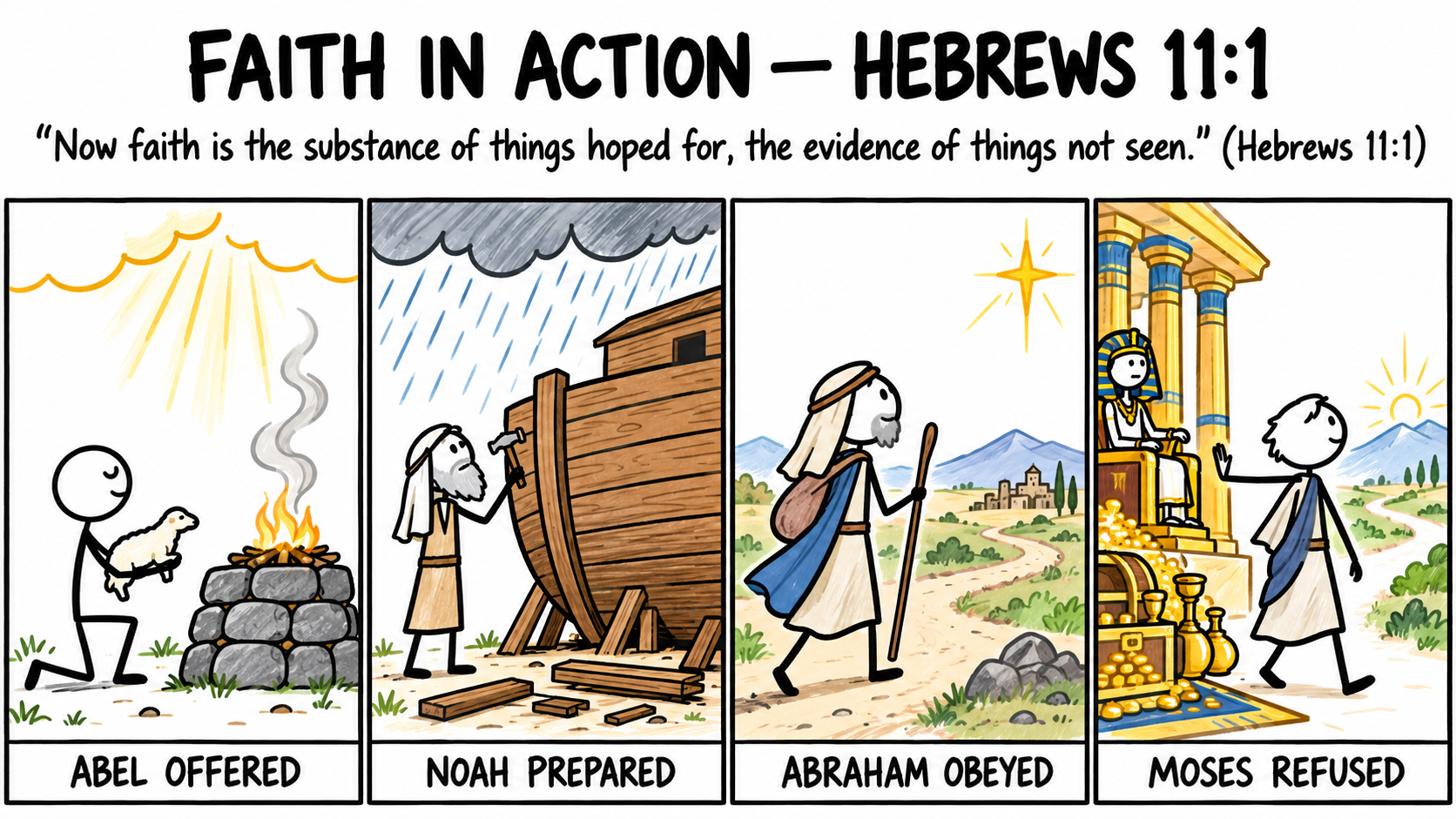
“Now faith is the substance of things hoped for, the evidence of things not seen” (Hebrews 11:1).
This verse isn’t a dry dictionary definition, because it tells us what faith does. When we have faith, we take God’s future promises seriously today, and we treat what we can’t see as certain because God has said it.
That’s why the words “by faith” come up again and again in this chapter, and each time, someone does something:
- Abel offered.
- Noah prepared an ark.
- Abraham obeyed and left home.
- Moses refused Egypt’s treasures.
Faith in the Bible isn’t wishful thinking or just hoping things turn out fine. It’s trusting God enough to get up and move.
Faith Holds On Before It Sees
One thing that really stands out in Hebrews 11 is that many of these heroes never saw the full promise come true in their lifetime. Speaking of Abraham, Sarah, Isaac, Jacob, and Joseph, the writer says: “These all died in faith, not having received the promises” (v. 13).
But they didn’t give up on God just because the promise seemed slow in coming. They lived as “strangers and pilgrims,” because they knew God’s city and kingdom were still ahead of them.
Abraham is the clearest example, because he lived in tents in the land God promised him, yet he was “waiting for the city which has foundations, whose builder and maker is God” (v. 10). He wasn’t just hoping for a piece of land or a quick answer, because he trusted the God who builds things that can’t be shaken.
So waiting doesn’t mean our faith has failed. Most of us here in Majuro know how it feels to sit and wait when Air Marshall Islands pushes a flight back again, but waiting on God is different, because His word never gets cancelled. Waiting on Him can be one of the clearest ways we show our faith.
Faith Reasons From God’s Promise
Hebrews 11 doesn’t ask us to stop thinking when we trust God. When Abraham offered Isaac, he did it because he “concluded that God was able to raise him up, even from the dead” (v. 19).
Abraham thought it through based on what God had already said. God had promised that Abraham’s descendants would come through Isaac, so even if Isaac died, God would still keep His word.
We see this in Genesis 22:5, when Abraham told his young men to wait with the donkey, because he and Isaac would go and worship and then come back to them. He knew God had told him to go and sacrifice his son, but he still said "we will come back."
Faith doesn’t mean pretending hard things aren’t real. It means we put God’s promise at the center of what’s real, and we say, “God has spoken, so His word must stand.”
Faith Does Not Guarantee an Easy Road
Hebrews 11 doesn’t give us a shallow picture of faith. The chapter tells of amazing victories, like kingdoms conquered, lions’ mouths shut, enemies defeated, and the dead raised to life, but it also tells of torture, mockery, prison, poverty, and death.
Things turn in verse 35, where some people were rescued, while “others were tortured, not accepting deliverance, that they might obtain a better resurrection.”
So trusting God might lead to rescue, or it might lead us through suffering, and neither one tells us whether God is pleased with our faith. God was still pleased with the people who suffered, and the writer even calls them people “of whom the world was not worthy” (v. 38).
Going through hard times doesn’t prove our faith has failed. Sometimes just staying faithful through it all is the victory.
Faith Looks Beyond This World
Again and again, Hebrews 11 points us past what we can see. Faith starts when we understand that God made the world by His word, and when we trust that He exists and that He “is a rewarder of those who diligently seek Him” (v. 6).
That’s how Moses could walk away from all the wealth of Egypt. He considered “the reproach of Christ greater riches than the treasures in Egypt,” because “he looked to the reward” (v. 26). He knew that money and comfort in this life aren’t what really count in the end.
When we trust God, we start to see what really matters, and that changes what we care about.
Jesus Is the Goal of the Story
The heroes of Hebrews 11 aren’t meant to be the main point, because their stories point us past them to Jesus. They lived by faith, but Jesus is “the author and finisher of our faith” (Hebrews 12:2).
They waited for God’s promises, and Jesus keeps them. They ran with endurance, and Jesus ran the whole race and finished it perfectly. They looked for a better country, and Jesus makes sure we have a kingdom that can’t be shaken.
Hebrews 11 asks us to trust God the same way and keep going: to take Him at His word, obey Him even when it costs us, stay faithful when the promise feels far away, and keep looking to Jesus.
Faith isn’t just believing that God can do something. It’s choosing to keep trusting Him and obeying Him, because He has spoken.
Add new comment